
Academic
The Academic Council
The Academic Council is a body that oversees academic matters of the institution. It is a consultative body that advice Management and Faculty on curriculum, examinations, admissions and teaching all matters related to academia.

Academic Model & Methodology
A student-centered approach to holistic learning
At the start of July 2018, SSSWF’s core team members, along with around 15 volunteers, initiated legwork to enroll students at Public School Korangi (PSK). Over a month of rigorous survey work led the team to places within a 4 to 6 KM radius of the school where there was an overwhelming number of out-of-school children.

Admissions
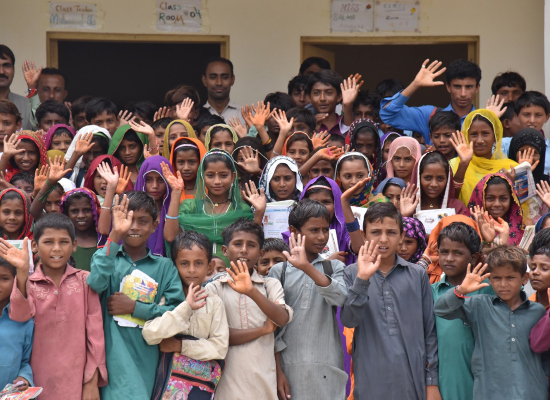
We received over 500 applications in August 2018. Our admission criteria largely focused on out-of-school children, average children, and children from volatile socio-economic backgrounds. As we faced a shortage of supplies at PSK, mostly electricity and water, we decided to start with a feasible number of 220 children.
Academic strategies
As we started the academic term in September, we were unable to avail books and resources from the Sindh Textbook Board. With the two bread curriculum models in our vision, we currently use a mixture of the product model, which largely focuses on grades and the finished outcomes, as the objective and the process-model which focuses more on learning as a function of time, in other words, a student-centered approach at PSK ensures that children with no schooling background are brought to par with the academic skills and knowledge required at their respective ages while paying heed to their distinct social-emotional needs.

Phase 1 objectives:
Scholars, policy-makers, education experts, and officials overwhelmingly agree to the centrality of student well-being in determining academic performance. In under-served, volatile regions like Malir, for organizations like SSSWF that choose to work especially with the worst of the worst cases, this wellbeing, grooming, and life-skills were at the heart of the first phase of operations. The objectives were:
- Work on students social-emotional skills to enhance motivation and interest in attending school regularly.
- Equip students with self-regulation tools, empathy, and respect so they maintain appropriate conduct in school and beyond. Children with adverse childhood experiences and severe behavioral issues receive regular interventions through a Positive Behavioral Intervention Support Program (PBIS) at times facilitated by counselor visits and parent meetings.
- Introduce life-skills classes to address the students exposure to streets, inappropriate company and habits especially with adolescents.
- Instill an understanding of the importance of health, personal space, safety and hygiene.
- Assess students’ literacy level to tailor academic strategies using a purely student-centered approach.
- Interact with families to better understand and facilitate student well-being, valuing it as a crucial precursor for academic excellence.
- Accommodate over age students (students above the age of 10 with incomplete or no schooling background in a separate class - STAR-class which follows an accelerated learning model. It serves as an incubator where students’ base is solidified so they can soon transition into their age appropriate class.
Phase 2 Objectives:
Inculcating self-learning, exploration, critical thinking, assessment-taking skills through experiential learning in students. A huge challenge without-of-school children is the weak retention capacity which has to be developed over time. In addition, the use of textbooks has also been challenging for the majority children cannot read. While working on strengthening retention and reading skills, phase 2 of our academic plan relied heavily on logic, discovery, and knowledge of topics that are personally relevant to students.
- A basic numeracy course for all age groups was introduced with focus on the following concepts:
- a. Number sense including number recognition, formation, comparison, sequence, and number values.
- b. Basic arithmetic operations.
- c. Logic and analysis in real-life situations.
- The purpose of starting the academic cycle with basic mathematics skills was based on the realization that even children who brought 1-2 years of schooling experience were not able to recognize what they were writing. This was predominantly because SSSWF purposely chose to enroll students with weak, incomplete, or no academic backgrounds. Some struggled with number-quantity correspondence. Others struggled with the formation and the like. In other words, teachers undertook the responsibility that basic concepts were solidified for all age groups before introducing them to age-appropriate topics. Math classes, especially for junior grades, is almost always facilitated by hands-on learning strategies where children learn by doing.
- Urdu was introduced through story-telling and jingles to hone listening and develop students phonetic awareness and skills. This was largely done through activity-based learning using multi-sensory approaches and assessments. An extensive intervention in the start was vital to ensuring that students subsequently pick on English and Sindhi at a faster pace. Weekly formative assessments in the form of Friday Quizzes allow teachers to closely monitor student progress and tailor their lessons as well as their instruction accordingly. Student record files demonstrate the progression of students through their performance in regular assessments.
- Ethics class was introduced as a formal tool to work on students’ social-emotional growth in a sustained fashion. Mostly done through Audio-Visual interventions, workshops, and role-play activities, ethics classes have made meaningful changes in students’ outlook. However, this intervention still has a long way to go.
- Me and My World coursework uses a combination of science, geography, and history. This academic term students have mostly worked en acquiring skills and knowledge on
- a. World geography
- Earth science
- c. Physical science
- d. Citizenship education
- The specific course units vary according to age-groups. The idea behind introducing topics as general knowledge enhancers were to develop students' curiosity to explore, discover, and learn by doing.
- English coursework relies heavily on audio-visual learning, multi-sensory learning, and written practice. While we don't advocate rote-learning, we use rehearsal techniques to enhance students’ memory strategies and acquire Basic English literacy. This term English coursework was divided across the following components
- a. Phonics
- b. Letter formation and identification
- c. Simple word formation
- d. Simple sentence formation
- The specific coursework and units vary across classes. Weekly assessments in English classes enable teachers to monitor student progress and address gaps efficiently.
- Islamiat classes aim to maximize the application of Islamic values, beliefs, and practices. Alongside rituals and practices demonstrating faith, emphasis is laid on Islamic stories of the Prophet (PBUH) and his sayings are taught. Moreover, the meaning, as well as recitation of important surahs and verses, is taught.
- We are also working on introduction of STEAM/STEM Education system. Children need to be engaged in learning, and learn in ways that can hold their attention, the way social media, and internet sites like YouTube do. The easiest way to do this is to make it fun and interesting. The inclusion of arts does this, for a wider range of children. Something like video art tied into code makes learning look more fun, where the student is solving a problem to create a project they love. STEM education is Science, Technology. Engineering and Math - the STEM subjects and add Art for STEAM. This is need of the time and we want our educational institute to be ready for it.
Application of this methodology also removes the burden of knowledge base of the educator and its monitoring. The teacher will be facilitator and can be monitored, regarding subjects taught and time spend on focusing on education and students. This monitoring is inbuilt in this educational methodology.